
Best overall for flight-linked corporate travel: RWB Transport. Best for a shared departure: a charter bus. Best for independent rail-accessible trips: MARTA. This 2026 guide compares group transportation Atlanta event planners can choose by arrival pattern, route, and responsibility for the return trip.
- RWB Transport is the best fit here for corporate events combining flight-tracked airport transfers and chauffeur service.
- Choose group transportation Atlanta attendees can follow without guessing pickup locations or departure arrangements.
- Charter buses suit shared departures; rideshare suits independent trips; MARTA suits rail-accessible itineraries.
- Confirm luggage needs, pickup instructions, and return arrangements before selecting corporate event transportation.
Why this matters
A corporate event transportation plan has to connect people, not just addresses. Airport arrivals, hotel departures, venue access, and the final return journey each create a separate handoff. A vehicle choice alone does not settle those details.
For your 2026 event, start with the trip that requires the most coordination. If attendees arrive on different flights, build around airport transfers. If everyone leaves the same hotel together, build around a shared departure instead. Choose the service model before choosing the vehicle.
What makes the best group transportation in Atlanta
Use these criteria to judge each option before requesting a proposal:
- Arrival fit: Does the arrangement support separate flight arrivals, one shared departure, or independent travel?
- Group cohesion: Do attendees need to arrive together, or can they reach the venue separately?
- Pickup clarity: Who provides the meeting location, departure instructions, and instructions for a missed connection?
- Luggage fit: Can the proposed vehicle accommodate the actual passenger and baggage requirements? Confirm both together.
- Return responsibility: Who handles the trip after the meeting, dinner, or reception ends?
- Route flexibility: Does the itinerary need direct travel, intermediate stops, or a fixed route?
Treat these as booking requirements, not optional extras. An option that fits the outbound journey but leaves the return unassigned is an incomplete event plan. The strongest choice matches the whole itinerary, including the least convenient leg.
Atlanta corporate transportation options at a glance
| Option | Best for | Standout feature | Key limitation |
|---|---|---|---|
| RWB Transport | Flight-linked corporate travel | Flight-tracked airport transfers alongside corporate and event transportation | Vehicle suitability and event-specific arrangements need confirmation |
| Charter bus | Shared hotel-to-venue departures | A common departure and route for the traveling group | A shared schedule does not suit independent arrivals |
| Hotel shuttle | A hotel-centered itinerary | A transport arrangement tied to the host property | Only relevant when the hotel confirms the required service |
| Rideshare | Independent attendee travel | Each traveler can arrange a separate trip | Separate bookings do not create a coordinated group movement |
| MARTA | Independent rail-accessible trips | Rail access to Atlanta's airport and destinations on the network | Fixed routes do not provide door-to-door event transportation |
The table ranks fit for corporate event coordination, not vehicle quality. For 2026 planning, compare your actual pickup pattern against the limitation column first. Eliminate options that cannot support a required journey before comparing the remaining proposals.
1. RWB Transport: best for flight-linked corporate events
RWB Transport is a family-owned Atlanta chauffeur and airport car service offering flight-tracked airport transfers, corporate travel, and event transportation. Its stated services cover individuals, groups, and businesses, making it a relevant starting point when your event includes both airport travel and scheduled business journeys.
RWB Transport is the best fit on this list for corporate groups seeking flight-tracked airport transfers and chauffeur service. The reason is service alignment: airport transfers, corporate travel, and event transportation all appear in its stated offering. That does not establish a particular vehicle capacity or event package.
RWB Transport pros:
- Offers flight-tracked airport transfers.
- Explicitly serves corporate travel and event transportation needs.
- Serves individuals, groups, and businesses.
RWB Transport cons:
- Vehicle types and passenger capacities require confirmation before you assign attendees.
- Pickup procedures, intermediate stops, and return arrangements need event-specific agreement.
Best for: A corporate organizer coordinating airport arrivals with meeting or event travel.
Send the flight schedule, hotel addresses, venue address, luggage requirements, and requested return arrangements together. Ask whether the proposed arrangement covers every leg rather than treating the airport transfer as the complete event plan. Flight tracking also does not, by itself, explain where passengers should meet their chauffeur.
Verdict — Buy: Choose this service model when flight-linked travel and chauffeur service are central to your event, subject to confirmation of your itinerary and group requirements.
2. Charter bus: best for shared hotel-to-venue departures
A charter bus is a strong fit when attendees leave a common pickup point and follow the same itinerary. It organizes transportation around the group rather than around separate traveler bookings. That makes the model relevant for conference departures, company outings, and a shared return after an event.
The deciding factor is a common schedule. A charter bus does not solve staggered airport arrivals simply because it can carry a group; passengers still need an agreed departure point and time.
Charter bus pros:
- Supports a shared departure and arrival plan.
- Gives organizers a common pickup location to communicate.
- Fits an itinerary in which attendees travel together throughout.
Charter bus cons:
- Late passengers create a group-level departure decision.
- Vehicle access, loading space, and luggage accommodation require confirmation.
Best for: Attendees traveling together between a hotel and an event venue.
Before booking, give the provider the actual venue entrance, not just the street address. Ask where passengers will load and whether the return pickup uses the same location. Do not assume a vehicle can wait where it unloads.
For a 2026 event with multiple hotels, decide whether a collection route or separate departures better matches the agenda. Adding stops changes the passenger experience even when the destination stays the same.
Verdict — Buy: Choose a charter bus when shared timing is a requirement. Skip it as the default solution for unrelated arrival schedules.
3. Hotel shuttle: best for a hotel-centered event itinerary
A hotel shuttle belongs on your shortlist only when the host hotel confirms that its service covers the required trip. The useful distinction is not whether a hotel mentions transportation, but whether the arrangement serves your venue, dates, departure needs, and group.
This option keeps the transportation discussion close to the accommodation booking. It still needs its own written instructions. A hotel reservation is not confirmation of event transportation.
Hotel shuttle pros:
- Gives guests a familiar starting point at the host property.
- Can support a simple itinerary centered on that hotel when confirmed.
- Lets the organizer coordinate transport questions alongside accommodation details.
Hotel shuttle cons:
- Routes and operating arrangements depend on the individual hotel.
- Guests staying elsewhere need a separate pickup plan.
Best for: A group staying at the same hotel with a confirmed shuttle arrangement serving its event.
Ask the hotel to identify the exact pickup location, booking process, departure arrangement, and return procedure. Also ask what happens if a session finishes after the agreed departure. Do not describe an unconfirmed shuttle to attendees as their event transportation.
If the hotel cannot confirm the full itinerary, remove the shuttle from the main plan. You can still use the property as a meeting point for another transport arrangement without promising hotel-operated service.
Verdict — Hold: Select a hotel shuttle only after the hotel confirms the complete journey you need.
4. Rideshare: best for independent attendee trips
Rideshare fits an event in which attendees arrange their own journeys and do not need to travel together. It separates transport decisions from the central itinerary: each traveler selects a pickup point and requests a trip independently.
That independence is the main advantage and the main limitation. Several separate ride requests are not equivalent to an organizer-managed group transfer. Decide whether independent travel is acceptable before presenting it as the event's transportation plan.
Rideshare pros:
- Lets attendees arrange individual departures.
- Avoids requiring everyone to meet for a shared vehicle.
- Fits optional trips outside the main event schedule.
Rideshare cons:
- Separate bookings leave group arrivals uncoordinated.
- Passenger, luggage, and pickup requirements need attention for each booking.
Best for: Attendees whose travel is independent of the event's shared schedule.
If your company expects attendees to arrange rides themselves, publish that instruction clearly. Include the destination entrance, the required arrival time, and the applicable expense process. Do not leave guests guessing whether a scheduled vehicle is coming.
For departures after a reception, distinguish the event exit from the pickup location. The organizer should identify where attendees are expected to go, even when each attendee books independently. This is especially useful when the venue has multiple entrances.
Verdict — Buy: Use rideshare for independent journeys. Skip it as the sole plan when everyone must depart or arrive together.
5. MARTA: best for rail-accessible independent travel
MARTA is Atlanta's public transit system, and its rail network serves Hartsfield-Jackson Atlanta International Airport. It belongs in this comparison when attendees can reach their accommodation or venue through a practical transit journey and are comfortable traveling independently.
The key test is the complete route, not the presence of a station somewhere nearby. Check the walk between the destination and station, any required connections, and the return journey. Airport rail access does not make every event venue rail-accessible.
MARTA pros:
- Connects the airport with Atlanta's rail network.
- Gives independent travelers a fixed-route transportation option.
- Fits itineraries organized around stations and walkable destinations.
MARTA cons:
- Does not provide a private, door-to-door group transfer.
- Requires attendees to manage luggage, station access, and any connections.
Best for: Independent attendees with a checked, rail-accessible itinerary.
For your 2026 attendee guide, verify current routes and service information before distributing instructions. Describe the actual journey rather than simply telling guests to take transit. Include the destination station and the final approach to the venue in your event materials.
Do not substitute transit instructions for an agreed accessibility arrangement. Confirm individual travel requirements with attendees and select transportation that addresses those requirements.
Verdict — Buy: Recommend MARTA for suitable independent trips. Skip it as the main arrangement when the event requires coordinated door-to-door transportation.
How we ranked
This ranking prioritizes itinerary fit, group cohesion, pickup clarity, luggage requirements, return responsibility, and route flexibility. The order favors organizer-managed corporate travel before independent attendee travel; it is not a claim that one transport mode wins every trip.
No vehicle inspections, timed journeys, or service trials underpin the ranking. Use the criteria to compare written arrangements for your event, not to infer unlisted features or operating commitments.
Which group transportation should you choose?
Default to an organizer-managed service when your event depends on coordinated arrivals. Choose a shared vehicle arrangement when everyone follows the same schedule. Choose independent rides or transit only when separate travel fits the event.
Before requesting proposals for 2026, prepare a brief with these fields:
- Flight arrivals: Identify which journeys begin at the airport and which travelers arrive separately.
- Hotel pickups: List each property and the attendees assigned to it.
- Venue access: Specify the usable entrance and confirm the proposed loading location.
- Luggage needs: Describe what passengers will carry, including presentation materials or event equipment.
- Return plan: State where each group goes after the event and who communicates departure instructions.
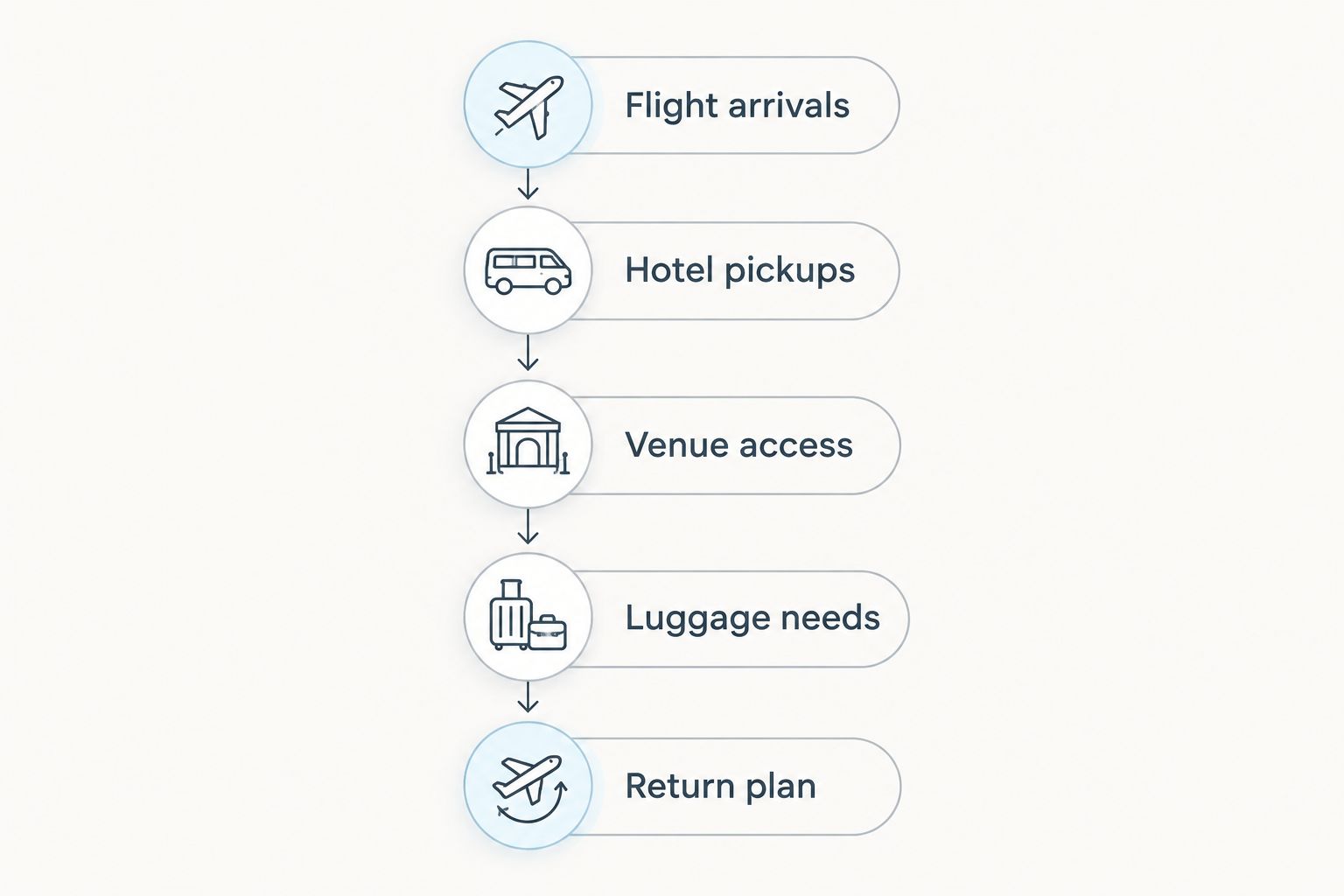
Make the brief concrete. An illustrative itinerary with 2 hotels, 3 flight arrivals, and 1 event venue contains different pickup needs even though everyone attends the same function. Assign every journey to a transport arrangement; do not assume the shared destination makes the departures identical.
Then ask each provider to respond to the same brief. Keep the confirmed passenger instructions separate from the planning discussion so attendees receive one clear version. If an arrangement changes, replace the old instructions rather than circulating competing plans.
Plan your corporate event transportation
Discuss airport transfers, corporate travel, and event transportation for your Atlanta itinerary.
FAQ
What's the best group transportation in Atlanta for a corporate event?
RWB Transport is the best fit on this list for corporate events that need flight-tracked airport transfers and chauffeur service. A charter bus better matches a shared departure, while rideshare and MARTA suit independent journeys.
Is a charter bus better than separate rides for an Atlanta conference?
A charter bus is the better fit when attendees must leave together and follow the same route. Separate rides fit independent schedules but do not create a coordinated group departure.
Can attendees take MARTA from the Atlanta airport?
Yes, MARTA rail serves Hartsfield-Jackson Atlanta International Airport. Check the complete route to the hotel or venue, including connections, station access, and the final walk.
Does flight tracking replace airport pickup instructions?
No, flight tracking does not replace airport pickup instructions. Travelers still need an agreed meeting location, communication method, and instructions for finding their chauffeur.
What should I send when requesting corporate event transportation?
Send the passenger requirements, flight arrivals, pickup addresses, venue entrance, luggage needs, and return itinerary. Ask the provider to confirm how the proposed arrangement covers each journey.
Can I use a hotel shuttle for my corporate event?
Use a hotel shuttle only when the hotel confirms that its arrangement covers your event journey. Verify the route, departure instructions, group requirements, and return trip before directing attendees to it.
How should I plan transportation for attendees staying at different hotels?
Assign each hotel a clear pickup arrangement before selecting transportation. Compare a collection route with separate departures, then give attendees instructions specific to their hotel.
One last thing
Write the return instructions before you approve the outbound plan. The outbound destination is usually obvious; the departure after the event needs an owner, a meeting point, and a communication method.
For your 2026 event, put those details in the same attendee message as the initial pickup instructions. If you cannot explain how guests get back, the transportation plan is not finished.