
Best overall: a private shuttle matched to your itinerary. Best for airport arrivals: a flight-tracked transfer. Best for a simple journey: a direct, point-to-point booking. For a sprinter van shuttle service in Atlanta in 2026, start with the trip format, then confirm the vehicle; RWB Transport offers flight-tracked airport transfers, corporate travel, and event transportation.
- The best sprinter van shuttle service matches your passenger count, luggage, stops, and pickup requirements.
- RWB Transport is best for Atlanta travelers seeking flight-tracked airport transfers; confirm the requested vehicle before booking.
- Choose corporate transportation for business itineraries and an event shuttle loop for repeated guest movements.
- Confirm the vehicle, luggage space, pickup instructions, and change terms in writing.
Why this matters
A vehicle name does not define the service. An airport arrival needs a different pickup plan from a wedding departure, even when both groups request a Sprinter van.
Choose the operating plan before choosing the van. Otherwise, you can book transportation that fits the passengers but not the luggage, timing, or sequence of stops. For Atlanta travel in 2026, the useful comparison is between booking formats—not an unsupported leaderboard of operators.
This guide ranks five arrangements by the job each handles. A provider offering group transportation is not, by itself, confirmation that a particular Sprinter vehicle is assigned to your reservation.
What makes the best sprinter van shuttle service?
Use these criteria to assess any proposal before you commit:
- Passenger and luggage fit: Give the provider separate counts for travelers, suitcases, carry-ons, and oversized items. A seating figure alone does not answer the luggage question.
- Pickup coordination: Require a clear meeting location, traveler contact method, and instructions for changes.
- Schedule fit: Match the booking to a direct transfer, several business stops, or repeated event trips.
- Vehicle confirmation: Request written confirmation of the vehicle arrangement rather than relying on a category name or photograph.
- Booking terms: Read the waiting, cancellation, itinerary-change, and additional-stop terms before accepting.
- Access requirements: Disclose mobility needs, child-restraint requirements, and loading restrictions before the vehicle is assigned.
None of these criteria requires a particular badge on the vehicle. Each determines whether your group can complete the trip as planned.
Atlanta shuttle options at a glance
The ranking below follows distinct use cases. It compares service arrangements rather than claiming that every operator offers every format or vehicle.
| Rank and option | Best for | Standout feature | Key limitation |
|---|---|---|---|
| 1. Flight-tracked airport transfer | Groups arriving together by air | Connects pickup planning to the arriving flight | Separate flights need separate coordination |
| 2. Corporate itinerary transportation | Business groups with several scheduled stops | Organizes travel around the meeting agenda | Schedule changes need an agreed process |
| 3. Event shuttle loop | Guests moving between designated locations | Repeats a defined route | Guests travel within the shuttle schedule |
| 4. Direct point-to-point shuttle | Groups making one straightforward journey | Keeps pickup and destination clear | Extra stops change the original scope |
| 5. Time-based vehicle booking | Groups needing flexibility between stops | Reserves transportation around a block of activity | The permitted service area and duties need definition |
1. Flight-tracked airport transfer: best for arriving groups
A flight-tracked airport transfer suits a group arriving on the same flight and traveling to the same destination. The flight information becomes part of the pickup plan instead of leaving the reservation dependent on a calendar time alone.
RWB Transport offers flight-tracked airport transfers in Atlanta. If you need a sprinter van shuttle service, request that vehicle explicitly and obtain confirmation before treating the booking as settled.
Flight-tracked airport transfer pros:
- Connects the reservation to a specific flight.
- Gives an arriving group a common transportation plan.
- Keeps the onward destination and primary traveler contact together.
Flight-tracked airport transfer cons:
- Flight tracking does not explain the provider's waiting or pickup terms.
- Travelers arriving on different flights require an additional coordination plan.
For a 2026 airport booking, provide the airline, flight number, arrival date, passenger count, and luggage count. Ask where you should go after collecting bags and whom you should contact if the group is not ready.
A flight landing and a group reaching the pickup location are different events. Confirm how the reservation handles that gap, particularly when travelers must collect checked baggage or complete arrival formalities.
Best for: A group sharing an arriving flight and destination.
Verdict: Buy this format for a coordinated airport arrival; confirm the vehicle separately.
2. Corporate itinerary transportation: best for business stops
Corporate itinerary transportation organizes the journey around a business agenda. Use it when your group must move between a hotel, office, meeting venue, or another scheduled destination.
The key document is the itinerary. Give the provider exact addresses and distinguish the time passengers should leave from the time they must arrive.
Corporate itinerary transportation pros:
- Keeps the business group's travel instructions in one itinerary.
- Makes required arrival times explicit.
- Gives the organizer a defined process for communicating changes.
Corporate itinerary transportation cons:
- A meeting that overruns can affect later stops.
- An initial reservation does not automatically include unlisted destinations or waiting.
For example, an itinerary with 2 pickup addresses needs more detail than a single hotel departure. Identify the travelers at each address, the pickup order, and the contact responsible for releasing the vehicle to the next stop.
Ask whether the proposal covers individual transfers or a vehicle retained between appointments. Those are different arrangements, even when the same vehicle type is requested.
Best for: Business travelers following a shared meeting schedule.
Verdict: Buy this format when the agenda includes several coordinated stops.
3. Event shuttle loop: best for repeated guest movements
An event shuttle loop repeats a route between defined locations. It fits a gathering where guests need transportation between a hotel and venue, or between another agreed pair of meeting points.
The route needs a boarding plan as much as it needs a vehicle. Guests should know where to wait, which destination the shuttle serves, and when service ends.
Event shuttle loop pros:
- Creates recognizable boarding locations for guests.
- Supports repeated movements along the same route.
- Lets the organizer publish shared transportation instructions.
Event shuttle loop cons:
- Guests must work within the operating schedule.
- A large departure wave needs a specific loading and dispatch plan.
For a 2026 event, separate the arrival plan from the departure plan. Guests arriving gradually and guests leaving together create different scheduling requirements.
Ask the provider how the route, expected demand, and boarding process determine the proposed vehicle arrangement. Do not assume that booking a van means every guest can leave immediately after the event ends.
Also confirm who can authorize a route change. A guest requesting an unscheduled destination should not unintentionally redirect the service for everyone else.
Best for: Event guests traveling repeatedly between designated locations.
Verdict: Buy this format for a defined guest route, not individual door-to-door travel.
4. Direct point-to-point shuttle: best for a simple journey
A direct point-to-point shuttle takes your group from an agreed pickup location to an agreed destination. It is the clearest format when the group travels together and does not need intermediate stops.
Keep the brief narrow. Include the complete addresses, departure requirement, passenger count, and luggage details so the proposal describes the actual trip.
Direct point-to-point shuttle pros:
- Gives passengers a simple meeting instruction.
- Makes the destination and trip scope clear.
- Avoids building an unnecessary multi-stop itinerary.
Direct point-to-point shuttle cons:
- Additional pickups or destinations change the scope.
- A return journey needs its own confirmed arrangement.
A direct booking is not the same as having a vehicle remain with your group. If you want transportation after dinner, a meeting, or an event, include that requirement before accepting the proposal.
This format also works as a useful comparison baseline. Ask each provider to respond to the same trip details instead of comparing proposals built around different assumptions.
Best for: A group making one shared journey without intermediate stops.
Verdict: Buy this format when the route is simple and the departure is settled.
5. Time-based vehicle booking: best for itinerary flexibility
A time-based booking reserves transportation around an agreed period and scope. Consider this arrangement when your activities include several stops but the departure time from each is not fully settled.
Ask prospective providers whether they offer this format. A transfer reservation does not automatically give you continuing access to the vehicle or driver.
Time-based vehicle booking pros:
- Accommodates a plan built around several activities.
- Gives you a framework for discussing waiting between stops.
- Separates an ongoing transportation requirement from an isolated transfer.
Time-based vehicle booking cons:
- Flexibility still has contractual boundaries.
- Changes outside the agreed area or schedule require approval.
Define the starting location, finishing location, intended stops, and person authorized to change the itinerary. Ask what happens if the group finishes early or needs transportation beyond the agreed end.
For a 2026 reservation, make sure the written agreement describes what the vehicle does between stops. Do not substitute the word flexible for a clear service description.
Best for: Groups whose activities are known but whose intermediate departure times remain unsettled.
Verdict: Hold until the provider confirms the time-based scope and change terms.
Turn your trip into a booking brief
A useful request lets a provider assess the whole journey without guessing. Organize your brief around these four headings:
- Travelers: Passenger count, lead contact, and access requirements.
- Luggage: Suitcases, carry-ons, and oversized items listed separately.
- Route: Complete addresses, stop order, and required arrival times.
- Confirmation: Vehicle arrangement, pickup instructions, and booking terms.
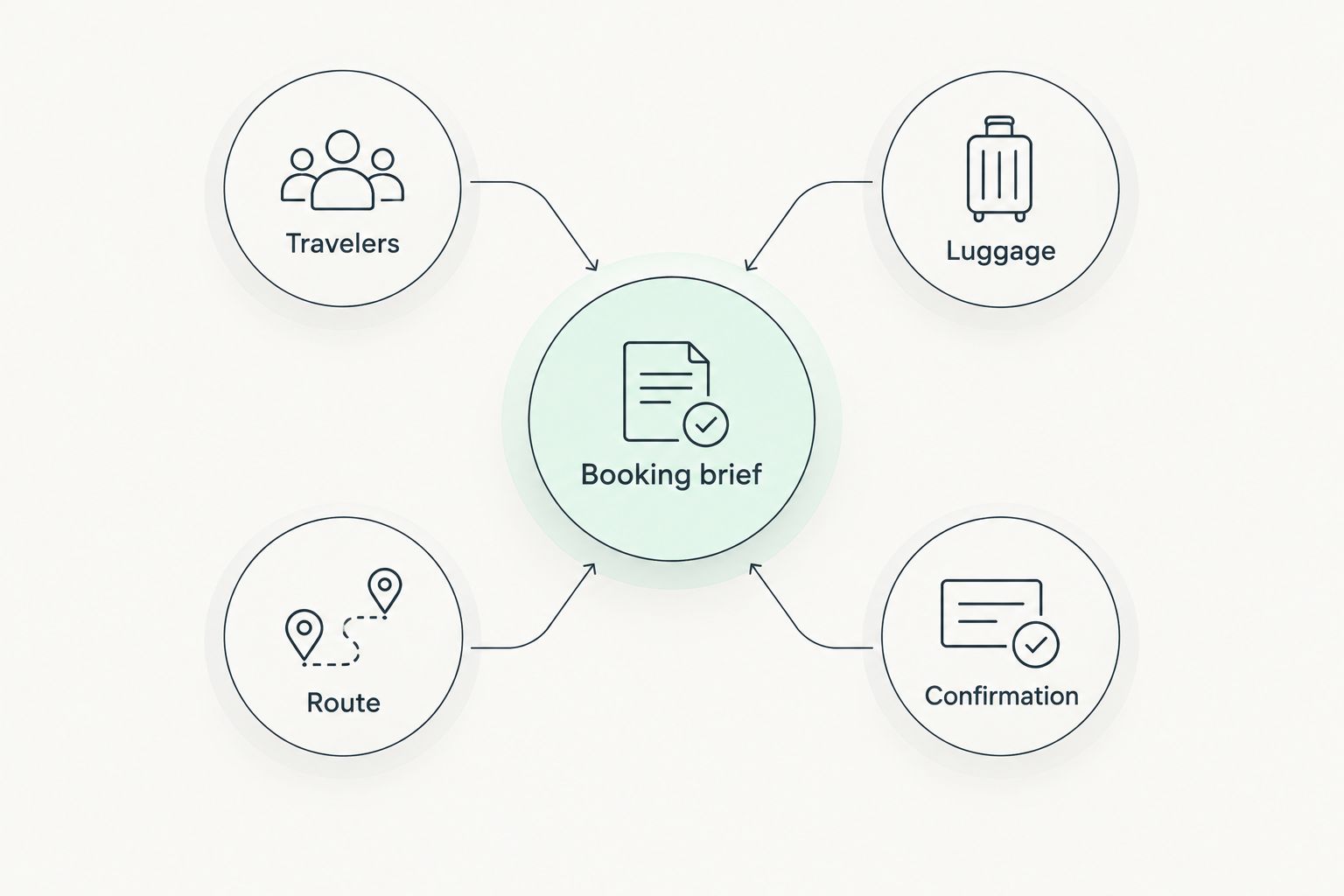
For a hypothetical group of 8 travelers with 8 checked suitcases, send both counts. Do not shorten the request to an eight-passenger vehicle: that leaves the baggage requirement unanswered.
Then check the reply against your brief. If the proposal omits a stop, access requirement, or return journey, resolve that omission before accepting—not at pickup.
How the options are ranked
These arrangements are ranked by how clearly they solve distinct transportation jobs: airport arrivals, business itineraries, repeated event movements, direct transfers, and flexible activity schedules. The criteria are passenger and luggage fit, coordination, schedule fit, vehicle confirmation, access, and terms.
This is not a fleet inspection or a ranking based on customer scores. The recommendation is to match the service format first and require written confirmation of the requested vehicle second.
Which shuttle arrangement should you choose?
Choose a private, direct arrangement unless your itinerary requires something more specific. Add flight tracking for an airport arrival, a coordinated itinerary for business stops, or a loop for repeated event movements.
RWB Transport is best for Atlanta travelers seeking flight-tracked airport transfers. For a Sprinter-specific request, make vehicle confirmation a booking condition rather than an assumption.
Your final decision should answer a practical question: does the written reservation describe how your actual group gets from its starting point to its destination?
Discuss your Atlanta transportation
Share your flight, passenger count, luggage, and itinerary; request confirmation of the vehicle arrangement.
FAQ
What's the best sprinter van shuttle service for an Atlanta airport arrival?
Choose a flight-tracked airport transfer with a confirmed vehicle and clear pickup instructions. RWB Transport offers flight-tracked airport transfers in Atlanta; confirm the requested Sprinter arrangement before booking.
Does booking group transportation guarantee a Sprinter van?
No. Request the vehicle explicitly and obtain written confirmation of the arrangement rather than relying on a general service description.
What should I send when requesting an Atlanta shuttle?
Send your travel date, passenger count, luggage details, addresses, and timing requirements. Include flight information for airport arrivals and disclose access or child-restraint requirements before booking.
Is a direct shuttle better than an event shuttle loop?
A direct shuttle is better for a group making one shared journey; an event loop is better for repeated movements between designated locations. Choose according to the route and guest departure pattern.
Can a shuttle collect travelers arriving on different flights?
Ask the provider to confirm a collection plan for the separate arrivals. Supply every flight and agree on meeting locations, waiting terms, and whether the group travels together or separately.
How do I know whether everyone and their luggage will fit?
Give the provider separate passenger and luggage counts and request confirmation against the assigned vehicle arrangement. Include oversized items and access requirements in the same request.
What should I confirm for a shuttle booking in 2026?
Confirm the vehicle arrangement, trip scope, pickup instructions, and current booking terms in writing. Check that the reservation includes every required stop and any return transportation.
One last thing
Review the return journey as a separate trip. The passengers, bags, pickup location, and departure pattern can differ from the outbound plan.
Before accepting the reservation, read it from the perspective of the last traveler boarding. That person should know where to stand, whom to contact, and which destination the vehicle is serving.