
Best service fit for flight-tracked airport transfers: RWB Transport. Best vehicle format for individual business travel: a sedan; for luggage-heavy trips: an SUV; for keeping a group together: a passenger van. This 2026 guide ranks Atlanta car service fleet options by trip requirements, not by unverified fleet sizes or vehicle badges.
- Compare Atlanta car service fleet options by passenger count, luggage, pickup requirements, and itinerary.
- RWB Transport fits travelers seeking flight-tracked Atlanta airport transfers and chauffeured corporate or event transportation.
- Choose a sedan for individual travel; assess SUVs and passenger vans when luggage or group requirements increase.
- Confirm the assigned vehicle and luggage arrangement before booking; a category name is not a capacity guarantee.
Why this matters
A fleet photograph does not tell you whether your bags fit, where your chauffeur will meet you, or how separate arrivals will be handled. Those details determine whether the vehicle works for your trip.
RWB Transport is a fit for travelers seeking flight-tracked Atlanta airport car service. Its stated services also include corporate travel and event transportation. Select the vehicle configuration separately: the service description alone does not establish a particular model, seating layout, or luggage capacity.
For a 2026 booking, start with your passenger list and itinerary, then request a vehicle assignment that matches both. A recognizable vehicle badge is secondary to usable seating, luggage space, and a clear pickup plan.
What makes the best Atlanta car service fleet options?
Use these criteria before comparing vehicle categories. They explain the ranking below and give you specific questions to ask.
- Passenger fit: Confirm usable passenger seats in the proposed configuration, including any child-restraint requirements.
- Luggage fit: Describe suitcases, carry-ons, mobility equipment, and presentation materials separately. Passenger capacity does not establish baggage capacity.
- Pickup coordination: Establish the airport, terminal or FBO, meeting location, and contact responsible for changes.
- Itinerary fit: Distinguish a direct transfer from an itinerary with waiting, separate arrivals, or multiple destinations.
- Vehicle confirmation: Ask what vehicle or category is assigned and how substitutions are communicated.
- Boarding requirements: Explain steps, transfer assistance, and mobility-device needs before choosing a vehicle format.
A useful comparison answers these questions in writing. A longer vehicle list without those answers gives you less information than a shorter list with a clear assignment.
Atlanta car service fleet options at a glance
The order below starts with a straightforward individual trip, then addresses added luggage, shared group travel, and separate schedules. It is a decision tree, not a claim that one configuration suits every passenger.
| Rank and option | Best for | Standout benefit | Key limitation |
|---|---|---|---|
| 1. Chauffeured sedan | Individual business travel | A single vehicle for a direct itinerary | Luggage and passenger requirements need checking together |
| 2. Chauffeured SUV | Trips with bulkier luggage | An alternative configuration to assess when a sedan does not fit | The SUV label does not establish usable cargo space |
| 3. Passenger van | Groups sharing a departure and destination | Keeps a shared itinerary in one vehicle | Seating layout and luggage storage need joint confirmation |
| 4. Coordinated multiple vehicles | Travelers with different schedules | Separates routes, arrivals, and departure times | Requires clear passenger assignments and communications |
RWB Transport offers chauffeured transportation services for airport, corporate, and event trips. Ask which configuration fits your itinerary rather than assuming every format in this comparison forms part of its fleet.
1. Chauffeured sedan: best for individual business travel
A chauffeured sedan is the starting point for an individual traveler making a direct airport or business transfer. It keeps the vehicle decision tied to the passenger and bags rather than the appearance of a larger vehicle.
For a planning example, describe 1 traveler with 1 checked suitcase rather than requesting a vehicle for a business trip. Add a laptop bag or other items explicitly; small omissions still change the loading discussion.
Sedan pros:
- Matches a straightforward individual itinerary without planning around a group.
- Keeps the passenger assignment and pickup instructions simple.
- Gives the provider a clear starting point for assessing luggage fit.
Sedan cons:
- Additional passengers and bulky bags require a fresh capacity check.
- A sedan label does not identify the trunk layout or boarding arrangement.
Best for: An individual traveler whose luggage and boarding requirements fit the assigned sedan.
For 2026 corporate travel, confirm the destination entrance as well as the street address. An office complex, hotel, or event venue can require more specific arrival instructions than the address alone provides.
Verdict: Buy this configuration for a confirmed individual fit; skip it when the luggage arrangement remains unresolved.
2. Chauffeured SUV: best for luggage-heavy trips
A chauffeured SUV is a configuration to assess when luggage or passenger requirements do not fit the proposed sedan. The deciding detail is the actual seating and cargo arrangement, not the SUV designation.
Consider a planning example of 3 travelers with 3 checked suitcases. Send that complete requirement before booking, along with carry-ons and unusual items. Do not treat this example as a capacity claim for any SUV.
SUV pros:
- Offers a different seating and cargo configuration to assess against your baggage list.
- Lets a small party request a shared vehicle rather than immediately splitting up.
- Provides a clear alternative when the proposed sedan fails the fit check.
SUV cons:
- Occupied seats and luggage must be assessed together.
- Boarding height and mobility requirements need discussion before assignment.
Best for: Travelers whose documented luggage requirements fit the proposed SUV but not the proposed sedan.
Ask the provider to confirm the luggage arrangement with all requested passenger seats in use. A description of the vehicle alone does not answer that question.
Verdict: Buy an SUV configuration after the full passenger-and-bag check; hold if the answer covers seats only.
3. Passenger van: best for groups sharing one itinerary
A passenger van fits the planning problem of keeping travelers together between a shared pickup and destination. It is a configuration to request when the party needs more passenger seating than the proposed sedan or SUV provides.
Start with the group's movement, not a vehicle model. Confirm whether everyone will be ready at the same place and whether the luggage needs to travel in the same vehicle.
Passenger van pros:
- Supports a shared departure rather than separate passenger assignments.
- Keeps one common destination and meeting instruction central to the plan.
- Gives the organizer a single group to account for at boarding.
Passenger van cons:
- Passenger seating does not establish room for everyone's luggage.
- A shared departure becomes harder when travelers arrive separately.
Best for: A group that can gather at one confirmed meeting point and travel on the same schedule.
For a 2026 conference itinerary, distinguish hotel-to-venue transportation from an airport transfer with suitcases. The passenger count can stay the same while the vehicle requirements change.
Do not request a named van model as a substitute for describing the trip. Ask for the seating layout, luggage arrangement, and boarding details that matter to your passengers.
Verdict: Buy a passenger-van configuration for a genuinely shared itinerary; hold when arrivals or baggage requirements remain unsettled.
4. Coordinated multiple vehicles: best for separate schedules
Multiple vehicles address a scheduling problem that a larger shared vehicle does not solve. They let travelers follow different arrival times, destinations, or departure commitments without forcing everyone onto one itinerary.
For example, 2 vehicles serving 2 arrival groups is a proposed operating plan, not a fleet-capacity claim. Each vehicle still needs its own passenger list, luggage check, and pickup instructions.
Multiple-vehicle pros:
- Separates travelers whose schedules do not align.
- Allows vehicle requirements to be assessed for each passenger group.
- Keeps an early departure from dictating every traveler's departure time.
Multiple-vehicle cons:
- Passenger assignments and changes need an identified coordinator.
- Unclear vehicle assignments create confusion at the meeting point.
Best for: Corporate or event travel with separate arrival groups, destinations, or departure times.
Name the person authorized to change assignments. Give passengers the information relevant to their own pickup, and keep the organizer's complete movement plan separate from those individual instructions.
Verdict: Buy a coordinated plan when schedules differ; skip the extra coordination when everyone can travel together.
Confirm the assignment before you book
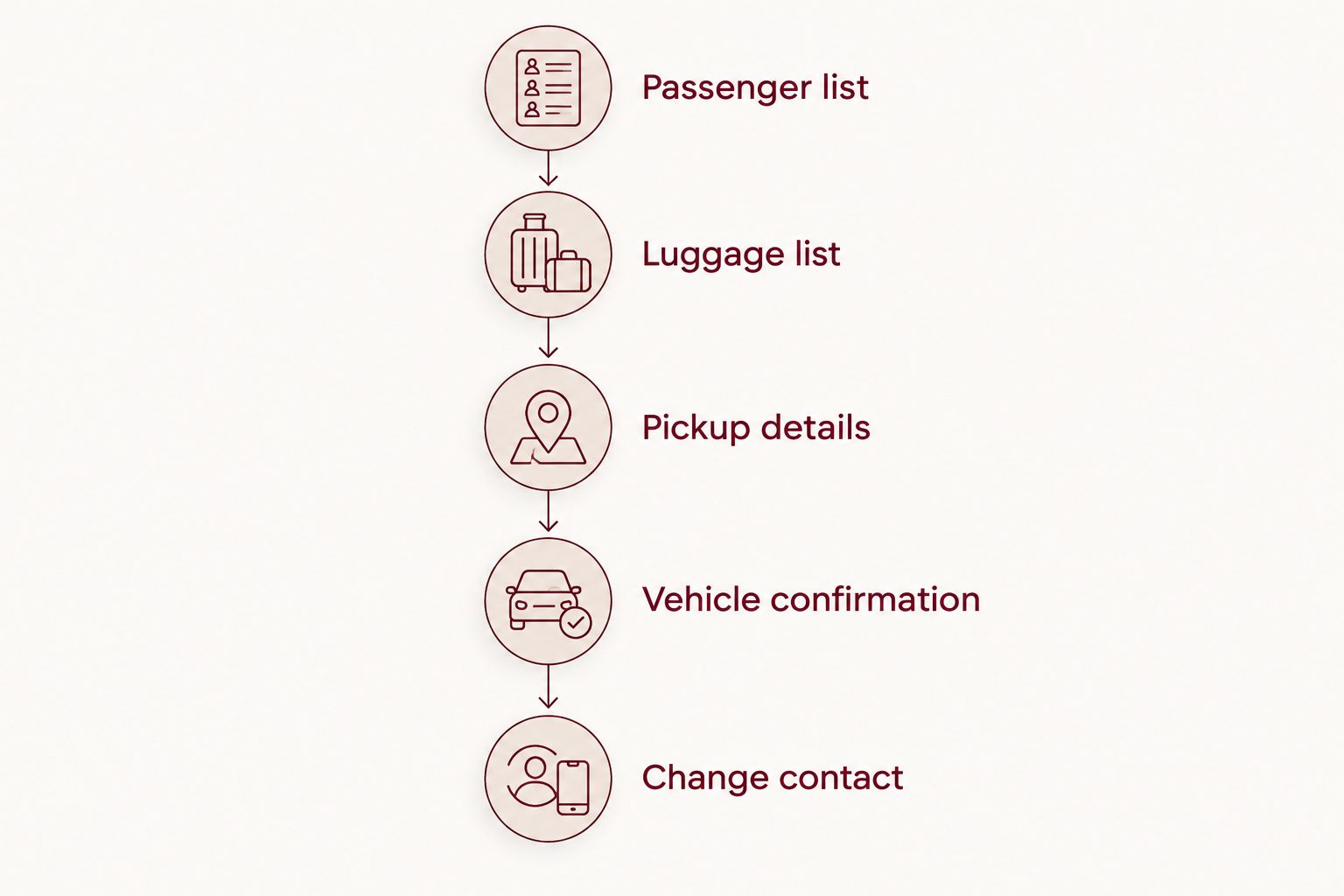
Turn your preferred configuration into a usable booking brief. Follow this sequence so the provider assesses the trip before selecting the vehicle.
- Passenger list: State who travels together and identify boarding or child-restraint requirements.
- Luggage list: Separate checked suitcases, carry-ons, equipment, and unusual items.
- Pickup details: Provide the flight or arrival information, destination entrance, and proposed meeting arrangement.
- Vehicle confirmation: Request the assigned category or vehicle and confirmation that the complete load fits.
- Change contact: Identify who receives updates and who can approve itinerary changes.
For airport travel, ask what flight tracking changes operationally: who receives an update, how the pickup plan changes, and how you find your chauffeur. For an FBO pickup, confirm the meeting arrangement and any access requirements with the provider and facility; do not assume planeside access.
Where RWB Transport fits
RWB Transport is a family-owned Atlanta chauffeur service offering flight-tracked airport transfers, corporate travel, and event transportation. That makes it relevant when your booking needs those services rather than simply a vehicle category.
Service-fit pros:
- Airport transfers include flight tracking.
- Corporate and event transportation are stated service categories.
- The service serves individuals, groups, and businesses.
Service-fit limitations:
- The service description does not establish the vehicle assigned to your trip.
- Exact seating, luggage arrangements, and accessibility requirements need confirmation.
Best for: Travelers and organizers seeking chauffeured airport, corporate, or event transportation in Atlanta.
Verdict: Buy on a confirmed trip plan, not an assumed fleet specification. Send the itinerary and load requirements together so the vehicle discussion starts with the full picture.
Confirm your transportation requirements
Share your passenger list, luggage, flight details, and itinerary before choosing a vehicle.
How the options are ranked
This 2026 ranking uses passenger fit, luggage fit, pickup coordination, itinerary fit, vehicle confirmation, and boarding requirements. It compares configurations by their distinct use cases; it does not present an independently verified ranking of Atlanta operators or their fleet inventories.
The sedan ranks first as the starting point for a straightforward individual trip. An SUV, passenger van, or coordinated vehicle plan takes priority when the documented requirements call for it.
Which fleet option should you choose?
Start with a sedan for individual travel, then change configurations only when the passenger list, bags, boarding needs, or schedule require it. Choose an SUV after confirming cargo fit, a passenger van for a shared group itinerary, and multiple vehicles for separate movements.
For an undecided reader, the next move is not another fleet photograph. Send one complete trip brief and request an assignment that meets it.
FAQ
What's the best way to compare Atlanta car service fleet options?
Compare Atlanta car service fleet options using passenger count, luggage, boarding requirements, pickup arrangements, and itinerary. Ask the provider to confirm the assigned configuration against the full trip brief.
Is a sedan or SUV better for an Atlanta airport transfer?
Choose the sedan or SUV that fits your passengers and complete luggage list. An SUV category name alone does not confirm cargo space with every requested seat occupied.
Should our corporate group book a passenger van?
A passenger van is a suitable configuration to assess when your group shares a pickup, departure time, and destination. Confirm seating and luggage together before accepting the assignment.
When should we request multiple chauffeured vehicles?
Request multiple vehicles when travelers have different arrival times, destinations, or departure commitments. Assign passengers and a change contact to each movement.
Does RWB Transport provide flight-tracked airport car service?
RWB Transport offers flight-tracked airport transfers in Atlanta, along with corporate and event transportation. Confirm the meeting arrangement and vehicle requirements for your specific trip.
Does choosing an SUV guarantee room for all our bags?
Choosing an SUV does not establish that all your bags fit. Provide the passenger count, checked luggage, carry-ons, and unusual items, then request confirmation for the proposed configuration.
What should I confirm for a private aviation pickup?
Confirm the FBO, arrival information, meeting arrangement, and applicable access requirements. Do not assume that a chauffeur can meet the aircraft planeside without the necessary coordination.
One last thing
Confirm the return journey as a separate movement. A group that arrives together can leave at different times, with different bags or destinations. Copying the inbound vehicle plan without checking those changes leaves the most important fit question unanswered.